 Refine
Active recall, built into your reading
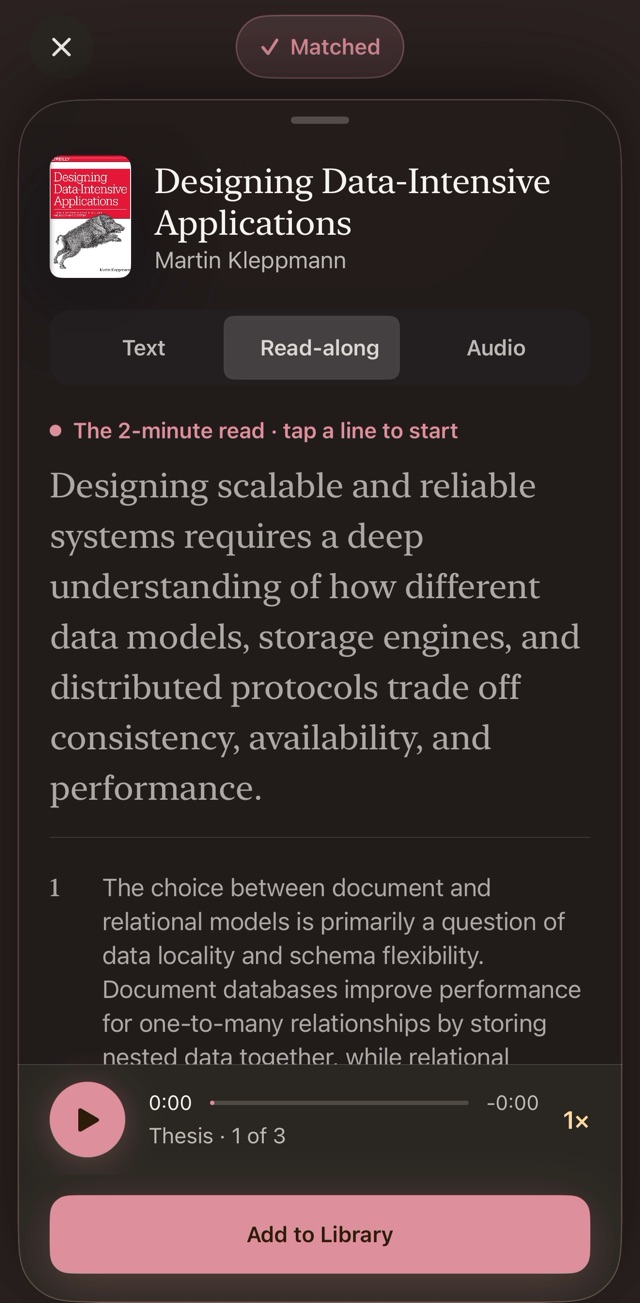
Reading a chapter twice feels like learning. Answering a question about it, from memory, actually is. That's active recall: pulling an idea back out instead of looking at it again, and it's the most reliable way to remember what you read. Refine builds it into the reading itself, so you don't have to write a single flashcard.
How Refine does it
- Read the chapter. Scan a book's cover, open a PDF or import an arXiv paper. Every chapter gets a two-minute read and a full read, with equations and code kept.
- Recall, don't reread. After a chapter, Refine asks short questions about its ideas: what it claims, why it holds, what follows from it. You answer from memory.
- Spaced repetition does the timing. Each idea comes back just before you'd forget it, a little later each time you get it right. Most days take a couple of minutes.
- Place the ideas yourself. Each chapter becomes a concept map. Putting the concepts where they belong is recall too, and the map is how you'll find them again.
Made for dense material
Physics, chemistry, biology, calculus, machine learning, computer science, finance: the books and papers where ideas build on each other and a week off loses the thread. Refine keeps the formulas and diagrams those chapters depend on, and asks about the reasoning, not just the vocabulary.
No deck to build
Flashcard apps work, but the cards are yours to write, and most people stop writing them. Refine writes the questions from the chapter you just read, so the review is ready the moment you finish.
What it is not
Recall questions help you keep a chapter; they don't replace working the problems. The full text is always one tap away.
Also works with
Textbooks, research papers, PDFs and documents you own, and pages you photograph. Every chapter also gets a concept map.
Read it once. Remember it for good.
Refine launches on October 19 on iPhone, iPad and Mac.
Get early access